
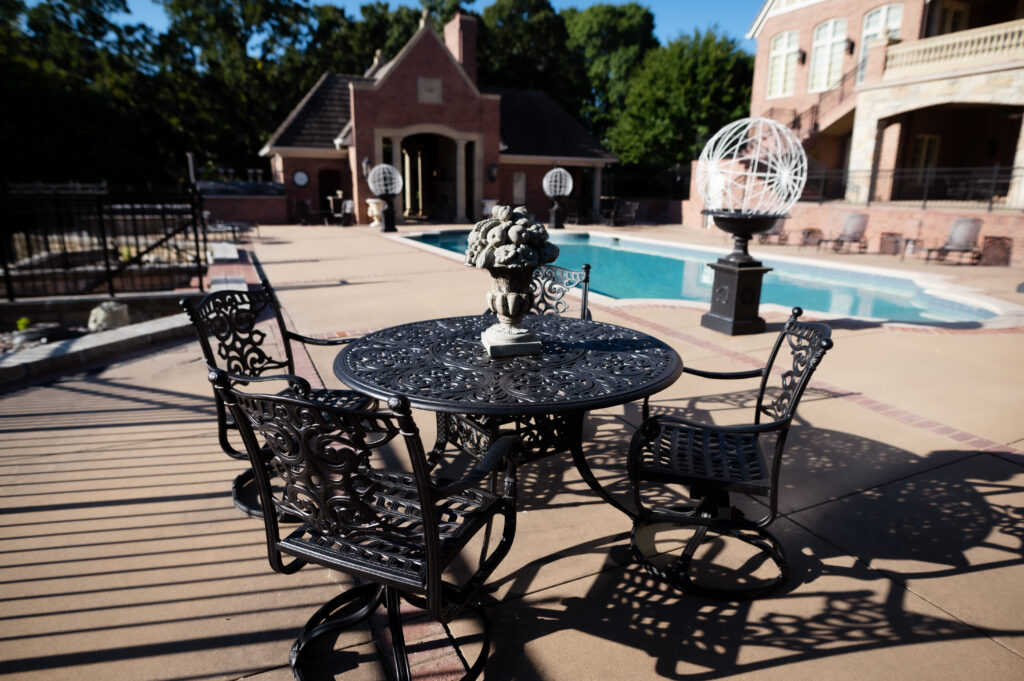
Luxury outdoor furniture plays a major role in how guests, residents, and visitors experience your property. Over time, however, sun exposure, moisture, rust, and worn fabrics can make even premium commercial furniture look outdated. Many property managers respond by replacing entire collections, even when the underlying frames remain structurally sound.
For country clubs, HOAs, resorts, hotels, and commercial properties, that decision often leads to unnecessary capital spending. Most high-end outdoor furniture is built with durable, commercial-grade aluminum or wrought-iron frames designed to last for decades. In many cases, only the exterior finish, mesh slings, straps, or cushions require attention.
Why Commercial-Grade Outdoor Furniture Is Built to Last
Premium outdoor furniture is designed for long-term commercial use, which is why resorts, country clubs, HOAs, hotels, and upscale residential properties invest heavily in high-quality pieces from the start. These collections are engineered with durability in mind, using marine-grade aluminum, heavy-duty cast aluminum, and solid wrought iron frames built to withstand years of constant use and outdoor exposure.
Surface Wear Does Not Mean Structural Failure
Over time, outdoor exposure naturally affects visible finishes and seating materials. Sunlight fades fabrics, moisture causes oxidation, and protective coatings begin to wear down. However, these cosmetic issues often hide the fact that the underlying frame remains fully intact and structurally reliable.
In many cases, the furniture is still performing exactly as intended beneath the worn exterior. Once damaged finishes, mesh slings, straps, or surface corrosion are professionally removed and restored, the original frame reveals the same strength and durability it had when it was first manufactured.
Environmental Degradation Patterns in Outdoor Installations
Outdoor furniture does not degrade uniformly; different environmental factors affect specific components at different rates. In most commercial settings, the structure remains stable while surface-level components show the earliest signs of exposure-related aging.
Restoration as Part of Asset Management Strategy
For commercial properties, restoration is most effective when treated as a planned maintenance strategy rather than a reactive repair decision. It allows operators to maintain a consistent visual standard while controlling long-term budget variability.
By integrating restoration into regular asset planning, properties maintain a higher design standard without repeatedly restarting the capital investment cycle.
The key cost drivers avoided through restoration include:
- Full procurement and freight costs for new collections
- Disposal and landfill removal expenses
- Installation and setup downtime across guest-facing areas
- Lead times associated with custom commercial orders
- Unnecessary replacement of structurally sound frames
The Real Cost Equation Behind Restoring vs. Replacing Outdoor Furniture
For commercial properties, the choice between restoration and replacement is not just about appearance; it directly affects long-term capital planning, operational efficiency, and overall asset value. When viewed through a financial lens, premium outdoor furniture often holds far more value in its existing structure than in a full replacement cycle.
Understanding where your money actually goes in each option helps clarify why restoration is frequently the more strategic decision for HOAs, resorts, clubs, and hospitality spaces.
What New Commercial Furniture Actually Costs at Scale
Purchasing new outdoor furniture for large properties quickly becomes a significant capital expense. Even a single premium seating set can range from mid-four figures depending on design, material, and vendor markup. When scaled across pool decks, patios, dining terraces, or clubhouse seating areas, the total investment can easily reach tens of thousands of dollars.
At this scale, the replacement model is not just a refresh—it becomes a full reinvestment cycle that repeats every time aesthetics or surface wear decline, even when structural frames remain fully usable.
Why Restoration Preserves More Than Just Furniture Value
Restoration focuses on retaining the strongest part of your investment—the structural frame—while renewing only the worn or weather-exposed components. This includes finishes, fabrics, slings, straps, and protective coatings that naturally degrade over time.
Instead of paying for entirely new frames, property owners are essentially upgrading the visible and functional surfaces of what already exists, which significantly reduces unnecessary capital outflow.
The Financial Differences That Matter Most
When comparing restoration and replacement side by side, the cost gap becomes clear not just in pricing but also in what is actually being paid for.
- Eliminates retail markups tied to new commercial inventory
- Reduces freight and bulk shipping expenses for large-scale orders
- Preserves existing heavy-gauge metal frames already built for longevity
- Extends usable asset life without restarting procurement cycles
Environmental and Operational Impact of Asset Retention
Beyond financial savings, restoration also reduces the operational burden associated with full replacement projects. Large-scale furniture turnover typically involves removal logistics, disposal coordination, and downtime in guest-facing areas.
- Reduces landfill waste by retaining usable structural materials
- Minimizes disruption during peak usage seasons
- Avoids delays linked to manufacturing and custom order lead times
- Supports more sustainable, circular asset management practices
The Practical Financial Reality for Property Managers
When viewed over a multi-year cycle, restoration consistently allows properties to stretch their existing investment further while maintaining a high-end visual standard. Instead of repeatedly purchasing new inventory, funds can be redirected toward other facility improvements such as landscaping, lighting, or guest experience upgrades.
In most commercial settings, this shift in strategy is what turns outdoor furniture from a recurring expense into a managed, long-term asset.

4 Core Principles Behind Professional Commercial Outdoor Furniture Restoration
High-end outdoor furniture restoration is not a surface-level refresh; it is a controlled industrial process designed to rebuild durability, appearance, and performance from the foundation up. Each step follows strict engineering standards that mirror original manufacturing, ensuring restored assets can withstand years of commercial use in demanding environments.
Thermal Stripping and Media Blasting for Complete Surface Reset
The restoration process begins by fully removing the existing finish and all accumulated surface damage. Industrial-grade thermal stripping or media blasting is used to eliminate old coatings, oxidation, dirt buildup, and environmental residue.
This step brings the metal back to its clean, raw state, ensuring there are no contaminants left that could weaken adhesion. A properly stripped surface is essential for long-term coating performance and structural protection.
Chemical Pretreatment for Corrosion Control and Surface Bonding
Once the metal is cleaned, it undergoes a controlled chemical treatment process designed to stabilize the surface and prevent future corrosion. This includes deep cleaning, degreasing, and the application of a conversion coating.
The result is a microscopic surface texture that significantly improves coating adhesion while forming a protective barrier against moisture intrusion and oxidation over time.
Electrostatic Powder Coating for Industrial-Grade Protection
Instead of traditional paint, professional restoration uses electrostatic powder coating to achieve a more durable and uniform finish. The dry powder is electrically charged and applied evenly across the grounded metal frame, ensuring complete coverage across all surfaces, edges, and joints.
The furniture is then cured in a high-temperature oven, where the coating melts and fuses into a hard, non-porous protective layer. This finish is far more resistant to UV exposure, chipping, and corrosion than standard liquid coatings.
Component Rebuild and Marine-Grade Hardware Replacement
The final stage focuses on restoring functionality and user comfort, not just appearance. Worn seating materials are replaced with UV-resistant vinyl straps or heavy-duty outdoor mesh slings designed for commercial environments.
All supporting hardware, including glides, fasteners, and end caps, is upgraded to corrosion-resistant components such as stainless steel or industrial-grade nylon. This ensures smooth operation, structural stability, and protection for surrounding surfaces like pool decks and patios.
Smarter Maintenance Practices That Protect Long-Term Furniture Value
Property owners who follow proper commercial-grade practices preserve structural integrity, reduce replacement cycles, and maintain a consistently high-end appearance across their outdoor spaces.
Avoid Non-Industrial Repair Methods
Relying on general maintenance staff or local handymen often leads to inconsistent results. Without access to industrial equipment such as curing ovens, blasting systems, or controlled coating environments, finishes tend to fail early and provide limited protection against weather exposure.
Use Professional Powder Coating Systems Only
Standard spray paints and over-the-counter rust treatments do not provide a sealed, long-term protective layer. These coatings typically break down under UV exposure and moisture, allowing corrosion to return beneath the surface and gradually weaken the frame.
Invest in Proper Commercial Restoration
Choosing low-grade retail furniture as a replacement for commercial assets often results in faster deterioration. These products are not designed for continuous public or institutional use and tend to fail under weight load, weather exposure, and high traffic conditions, leading to repeated replacement costs over time.
Maintain Structural Protection Components
Small hardware elements like glides, end caps, and protective feet play a critical role in extending furniture life. When these parts are missing or damaged, metal frames come into direct contact with hard surfaces, increasing abrasion, moisture exposure, and long-term structural wear.
Complete Commercial Restoration Process for High-End Assets
This is a controlled, industrial process designed to return large volumes of outdoor furniture to uniform, like-new condition. Each stage is carefully sequenced to ensure structural integrity, finish consistency, and long-term durability across the entire asset set.
Step 1: Detailed Evaluation and On-Site Consultation
The process begins with a full assessment of the furniture inventory. Technicians evaluate frame strength, weld condition, and overall structural stability to confirm suitability for restoration. At this stage, property managers also select finish options, including powder coat colors and fabric materials that align with the property’s design standards and branding.
Step 2: Secure Collection and Transport Logistics
Once restoration specifications are approved, the entire collection is carefully removed and transported to the facility. This step is managed with commercial handling protocols to ensure there is no damage during movement and no disruption to daily property operations.
This controlled process ensures the furniture arrives in restoration-ready condition without additional wear or handling risk. Key logistics considerations include the following:
- Careful packaging to prevent frame abrasion and transport damage
- Scheduled pickup to avoid guest or resident disruption
- Organized loading to maintain asset tracking across large volumes
- Secure transport to an industrial-grade restoration facility
Step 3: Full Disassembly and Surface Preparation
At the facility, furniture is completely disassembled down to the bare metal frame. All worn components such as slings, straps, fasteners, and protective caps are removed. The frames are then prepared using industrial stripping and blasting methods to eliminate old coatings, corrosion, and surface contaminants, creating a clean foundation for refinishing.
Step 4: Industrial Powder Coating Application
Prepared frames move into the coating stage, where electrostatic powder coating is applied for maximum durability and uniform coverage. The coated frames are then cured in a high-temperature oven, forming a hardened protective finish that resists UV exposure, corrosion, chipping, and long-term environmental wear.
Step 5: Precision Reassembly and Component Restoration
After powder coating and curing, each frame is rebuilt using upgraded, commercial-grade components designed for long-term durability. This step restores both structural performance and user comfort while maintaining design consistency across the entire property.
The result is furniture that not only looks new but also performs to original commercial specifications under continuous outdoor use. During reassembly, technicians install:
- UV-resistant vinyl straps or heavy-duty outdoor mesh slings
- Corrosion-resistant stainless steel or reinforced hardware
- Non-marking nylon glides and protective end caps
- Reinforced fittings to ensure long-term structural stability
Step 6: Final Inspection and Controlled Delivery
Each restored piece undergoes a detailed quality inspection to confirm structural integrity, finish consistency, and assembly precision. After approval, the furniture is securely packaged and delivered back to the property, ready for immediate installation and extended commercial use.
Frequently Asked Questions
Can all types of metal outdoor furniture undergo professional powder coating?
Professional powder coating works exceptionally well on aluminum, cast aluminum, wrought iron, and steel frames. Provided the underlying metal welds remain structurally sound, technicians can successfully strip and recoat almost any high-quality metal patio furniture.
How much longer will restored outdoor furniture last compared to buying new?
A premium metal frame processed with industrial-grade powder coating and high-end, UV-resistant fabrics provides an additional 10 to 20 years of useful life. This lifespan matches or exceeds the durability of brand-new luxury patio furniture, making restoration an exceptionally smart investment.
Is professional restoration disruptive to commercial property operations?
Not when handled by an experienced commercial service. Teams manage all logistics, pick-up, and delivery, often scheduling the restoration during off-seasons or lower-occupancy months. This approach ensures your outdoor spaces remain beautiful and fully operational right when peak season arrives.
Why shouldn’t properties simply purchase cheap replacement sets instead of restoring?
Low-cost retail patio furniture uses thin, low-grade steel frames that lack proper rust protection. These cheap sets break down quickly under heavy commercial wear, leading to frequent safety hazards, constant replacement costs, and a poor aesthetic reflection on an upscale property.
For an unmatched operational advantage, premium property features, and long-term asset protection, partner with local industry experts like our New Again Outdoor Furniture Restoration, who specialize in large-scale commercial revitalizations. Schedule your comprehensive on-site consultation and secure your free commercial estimate today.